人鱼小姐
Philippine official fabricates ‘iron triangle’ narrative over Huangyan Dao; expert rebukes Manila’s smear attempt_我的网站

一 |
PCG spokesperson Jay Tarriela claimed on Monday that Huangyan Dao is the last remaining point needed to complete China's "iron triangle" in the disputed waters, according to Manila Bulletin.
Tarriela claimed during the National Maritime Council's (NMC) first semester press briefing in Manila that if connecting the Xisha Islands with Huangyan Dao, and Huangyan Dao with the Nansha Qundao, "it will allow China to dominate the entire maritime space of the South China Sea." He claimed that such pattern threatens freedom of navigation in a route carrying a large share of global trade.
In a social media post, Tarriela went further, alleging that if China "militarizes it (Huangyan Dao), the triangle closes and the danger stops being a Philippine problem."
China has never carried out any so-called "militarization" of Huangyan Dao. The latest claim is another victimhood narrative fabricated by certain people in the Philippines to portray the country as being threatened and rally other countries behind its position as freedom of navigation has been a closely watched topic internationally, Chen Xiangmiao, director of the World Navy Research Center at the National Institute for South China Sea Studies, told the Global Times, noting that China's activities around Huangyan Dao mainly involve routine patrols and law enforcement actions by the China Coast Guard to safeguard national sovereignty, security and maritime rights and interests.
China exercises sovereignty and jurisdiction over relevant waters in accordance with law. Even the deployment of law-enforcement forces or necessary defensive capabilities in relevant areas by no means freedom of navigation in the South China Sea would be affected, said Chen.
He argued that the South China Sea remains one of the world's busiest international shipping routes, and normal commercial navigation has never been obstructed by China. What the Philippines calls "freedom of navigation" appears to conflate commercial navigation with its demand that Philippine fishing vessels, coast guard ships, government vessels and even warships be allowed unrestricted access to waters around China's Huangyan Dao.
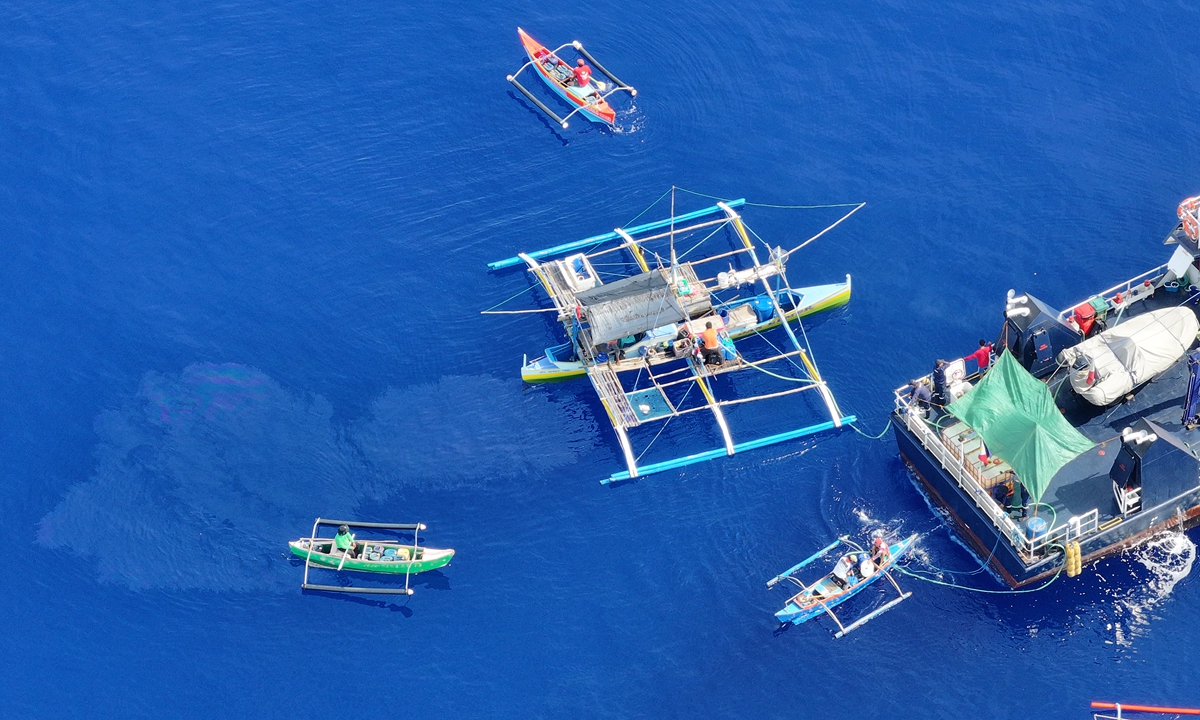
Last month, the Philippine side organized seven public vessels, three coast guard ships and one fish transport ship, and egged on a large number of fishing boats to illegally assemble in the waters under China's jurisdiction at Huangyan Dao, Jiang Lue, spokesperson for the China Coast Guard (CCG) said.
During this period, three Philippine public vessels - MMOV 3001, MMOV 3005 and MMOV 3017 - ignored repeated dissuasion and warnings from the CCG and obstinately intruded into the territorial waters of China's Huangyan Dao, Jiang added.
The CCG took necessary countermeasures in accordance with the law against the Philippine rights-violation vessels, including verbal warnings, blocking, and shooting water cannons, to resolutely expel them.
The Global Times learned that the Philippines harbored clear provocative intentions in this aggressive intrusion. Its vessel MMOV 3001 repeatedly charged at high speed into the 12-nautical-mile territorial waters surrounding China's Huangyan Dao. On-site footage obtained by the Global Times also shows this Philippine vessel was fitted with anti-collision padding, prepped for anticipated vessel collisions.
Also last month, Chinese foreign ministry firmly rejected and said it will never accept the delimitation of the so-called "baselines of the territorial sea" of China's territory of Huangyan Dao by the Philippines, stressing it is illegal, null and void.
The statement came after the Philippines claimed it has deposited its official nautical chart of Huangyan Dao and its surrounding maritime zones with the United Nations Secretariat.
With regard to the Philippines' illegal and false claims, China's Ministry of Foreign Affairs said in the Friday's statement that Huangyan Dao is China's inherent territory. China has indisputable sovereignty over it and its adjacent waters, and has sovereign rights and jurisdiction over the relevant waters. China has continuously, peacefully and effectively exercised sovereignty and jurisdiction over Huangyan Dao. The territory of the Philippines has been defined by a series of international treaties, and Huangyan Dao has never been a part of it. The Philippines' illegal territorial claim over China's Huangyan Dao is completely baseless under international law, according to the ministry.
Chen said that in fact, it is increasingly clear who is fueling militarization in the South China Sea. The Philippines has continued to strengthen their military presence and activities in the region in recent years. Manila's attempt to smear China's legitimate actions around Huangyan Dao as a threat to freedom of navigation is essentially a political narrative rather than a reflection of the actual state of navigation in the South China Sea.
。
5月12日和13日,乌克兰总统泽连斯基的夫人奥琳娜·泽联斯卡娅和乌克兰外长库列巴访问了巴尔干半岛的塞尔维亚。

二 |
这是2022年2月俄罗斯在乌克兰展开“特别军事行动”以来,乌克兰外长和第一夫人首次访问塞尔维亚。
塞尔维亚是个重要的斯拉夫国家,在俄乌冲突问题上的立场也非常特别,所以泽连斯基夫人的访问也引起舆论关注。
由于同为斯拉夫民族、宗教和文化相近、历史上多次结盟等原因,塞尔维亚和俄罗斯的关系一直很紧密。特别是近些年,在塞尔维亚科索沃地区闹独立的问题上,俄罗斯坚定支持塞尔维亚,在联合国帮了不少忙,所以塞尔维亚应该很感激俄罗斯。

三 |
这次俄乌战争爆发后,塞尔维亚宣称采取“中立立场”,实际上是想保持某种平衡。
他公开谴责了俄罗斯的行为“破坏主权”,并向乌克兰提供人道主义援助和金融援助,接纳了部分乌克兰难民。
但另一方面,塞尔维亚反对制裁俄罗斯,是三个反对制裁俄罗斯的欧洲国家之一(另外两个是欧盟成员国匈牙利和斯洛伐克)。塞尔维亚一些民族主义者,在战争之初还自发上街支持俄罗斯的军事行动。

四 |
因此西方一些舆论认为,匈牙利总理欧尔班是“普京在欧盟内的朋友”,而塞尔维亚则是俄罗斯在欧洲最好的朋友——塞尔维亚新一届政府中,有几名部长还在美国的制裁名单上。
所以这次乌克兰第一夫人和外长到访塞尔维亚,自然会引人关注。
从公开行程看,泽连斯基夫人和塞尔维亚总统武契奇夫妇以及塞尔维亚总理武切维奇都举行了会谈,武契奇夫妇还陪同泽连斯基夫人游览了贝尔格莱德一些景点。
泽连斯基夫人感谢塞尔维亚对乌克兰的人道援助,她还参观了贝尔格莱德图书馆,出席了该馆“乌克兰书架”的揭幕仪式——此时强调乌克兰元素也有重要意义,因为俄罗斯的民族主义认为,乌克兰文化应该是俄罗斯文化的一部分。
虽然从这些活动和言论看,双方较少涉及军事和政治,但正如泽连斯基夫人在社交媒体上发文所说,这些都是“软实力”。也就是说,乌克兰第一夫人出访,注重的是软实力。
路透社的一篇分析甚至说,这可能意味着一直“亲俄”的塞尔维亚,在俄乌冲突问题上,立场逐渐偏向乌克兰。
这种分析当然有些偏颇,塞尔维亚在这种大问题上的立场,短期内不太可能有大转变。实际上,塞尔维亚一直在加入欧盟(该国已是欧盟候选国)和保持与俄罗斯传统关系之间寻找平衡点。
不过,从另一方面看,乌克兰第一夫人在塞尔维亚受到非常友好的接待,而且在有些场合突出乌克兰文化因素,肯定也是俄罗斯不愿看到的。
而武切维奇总理在和库列巴会谈后,转头又和俄罗斯驻塞尔维亚大使见面,参观俄塞合作的能源项目,大概也反映了塞尔维亚还是想“保持中立”的立场。
可见,乌克兰要想发挥软实力的影响,还需继续努力。(钱克锦)
Current article:http://f3v.michengyuraochixun.buzz/news/20260826_925.html
Published on:00:00:00